

HTTP/2 and HTTP/3 (QUIC) Protocol Mechanics: Multiplexing, QPACK, and 0-RTT Transport
A deep technical breakdown of HTTP/2 and HTTP/3 transport layers, examining binary framing, TCP head-of-line blocking, UDP-based QUIC connection migration, and QPACK header compression.
The transition from text-based HTTP/1.1 to binary-framed HTTP/2 and UDP-native HTTP/3 represents the most fundamental architectural shift in web transport infrastructure over the past two decades. While HTTP/1.1 relied on multiple TCP connections or fragile application-layer pipelining, HTTP/2 introduced binary framing and stream multiplexing layered over TCP with TLS. Building on this evolution, HTTP/3 runs over QUIC, which integrates reliable transport, stream multiplexing, loss recovery, congestion control, and the TLS 1.3 handshake directly over UDP.
Understanding the mechanics of HTTP/2 binary framing, TCP head-of-line (HOL) blocking, and QUIC transport semantics is vital for backend engineers configuring edge reverse proxies, building gRPC microservices, and optimizing API request latency.
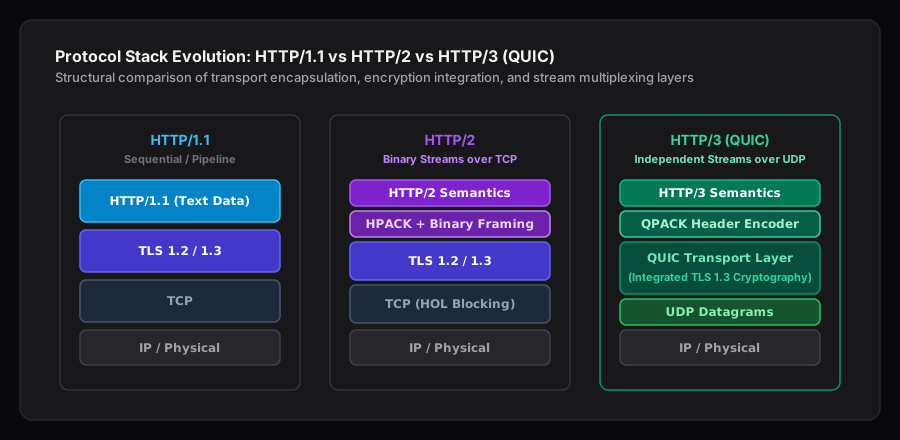
The Limitations of HTTP/1.1 Transport
HTTP/1.1 processes requests over stream-oriented TCP sockets using ASCII text headers and delimiter-based message boundaries (CRLF sequences). Although the HTTP/1.1 specification permits pipelining—allowing a client to issue multiple requests over a single TCP connection without waiting for individual responses—it mandates that servers return responses in strict request order.
Head-of-Line (HOL) Blocking at the Application Layer
Because response ordering is strictly fixed in HTTP/1.1, a slow request at the head of the pipeline blocks all subsequent responses behind it. If request 1 requires 800 ms of database processing on the server, responses for requests 2 through 5 cannot be sent back to the client—even if their processing completed in 2 ms.
Due to this application-layer head-of-line blocking and widespread implementation defects in network intermediaries (middleboxes and reverse proxies), modern web browsers disable HTTP/1.1 pipelining by default. Instead, browsers open up to 6 concurrent TCP connections per origin to achieve parallel downloads.
In a simplified sequential model over a single TCP connection without pipelining, the total round-trip latency \(L_{\text{total}}\) for \(N\) requests can be represented as:
$$\text{Latency}_{\text{HTTP1-Sequential}} = \sum_{i=1}^{N} \left( R_{\text{tt}} + T_{\text{processing}, i} \right)$$
where \(R_{\text{tt}}\) is the network round-trip time and \(T_{\text{processing}, i}\) represents the server execution time for request \(i\).
HTTP/2 Binary Framing & Multiplexing Mechanics
RFC 7540 eliminated HTTP application-layer head-of-line blocking by introducing a binary framing layer between application logic and the underlying TCP socket. Instead of transmitting plain-text HTTP messages, HTTP/2 breaks requests and responses into discrete binary frames, identified by a 9-octet frame header.
1. Structure of the 9-Octet Frame Header
Every HTTP/2 frame begins with a fixed 9-byte header:
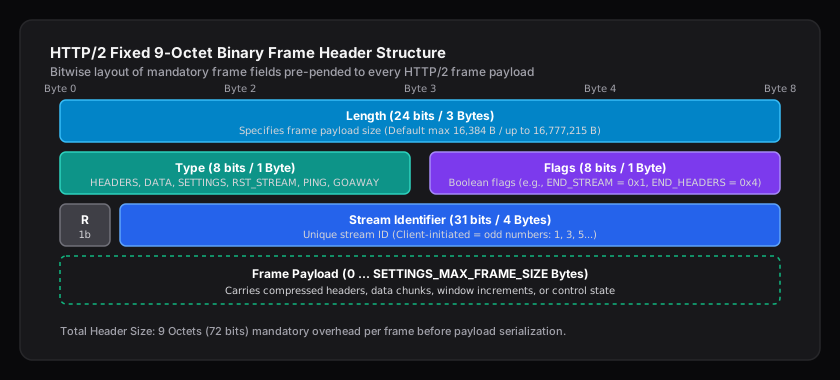
- Length (24 bits): Specifies the frame payload length. The protocol specification allows frame payload sizes up to \(2^{24}-1 = 16,777,215\) bytes. However, the default max frame size is \(2^{14} = 16,384\) bytes (
SETTINGS_MAX_FRAME_SIZE); larger payloads require explicit settings negotiation between endpoints. - Type (8 bits): Defines frame semantics (
HEADERS,DATA,SETTINGS,RST_STREAM,PING,GOAWAY,WINDOW_UPDATE). - Flags (8 bits): Boolean options tailored to frame types (e.g.,
END_STREAM = 0x1,END_HEADERS = 0x4). - Stream Identifier (31 bits): Uniquely identifies the independent logical stream to which the frame belongs. Client-initiated streams use odd numbers (1, 3, 5…). Even stream IDs were reserved for server-initiated streams (historically used for Server Push, which has since been deprecated or disabled by major browsers).
2. Stream Multiplexing and State Transitions
Because every frame carries an explicit Stream Identifier, frames from dozens of concurrent HTTP request/response cycles can be interleaved across a single underlying TCP connection simultaneously.
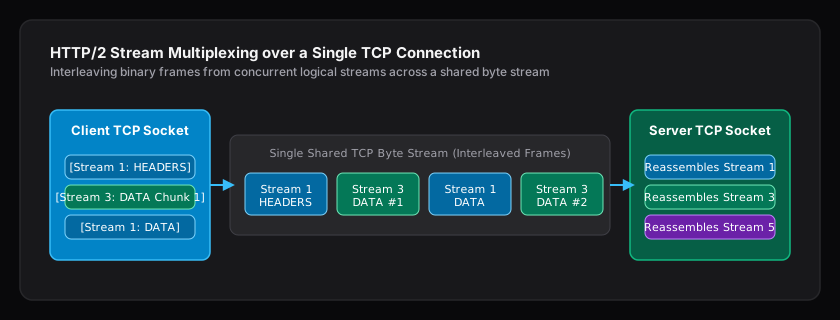
When analyzing connection performance with a Network Latency Calculator, multiplexing dramatically reduces latency degradation caused by establishing multiple cold TCP connections.
3. HPACK Header Compression
Repeated HTTP headers (e.g., User-Agent, Authorization, Cookie) account for hundreds of uncompressed bytes per request. HTTP/2 introduces HPACK (RFC 7541), which maintains a static table (61 predefined common headers) and a dynamic table synchronized between client and server over the lifetime of the TCP connection.
Instead of sending full header strings like user-agent: Mozilla/5.0..., HPACK transmits compact variable-length integer indices referring to dynamic or static table entries. Individual header string literals may also be optionally Huffman-encoded using a static Huffman code table when doing so yields a smaller payload.
The Flaw in HTTP/2: TCP Transport Head-of-Line Blocking
While HTTP/2 successfully eliminated application-layer head-of-line blocking, it exposed a lower-level architectural bottleneck: TCP transport head-of-line blocking.
TCP is a transport-layer protocol that is typically implemented within the operating system kernel to guarantee in-order, lossless byte-stream delivery. The TCP stack buffers incoming segments and presents them to the application as a contiguous byte sequence.
If a single TCP segment carrying a frame for Stream 3 is dropped on the wire, the receiving kernel’s TCP stack halts processing for all subsequent received bytes in the queue—including frames for intact Streams 1, 5, and 7—until TCP’s loss recovery algorithms (such as Fast Retransmit, RACK, or Probe Timeout) retransmit the missing segment and in-order delivery resumes.
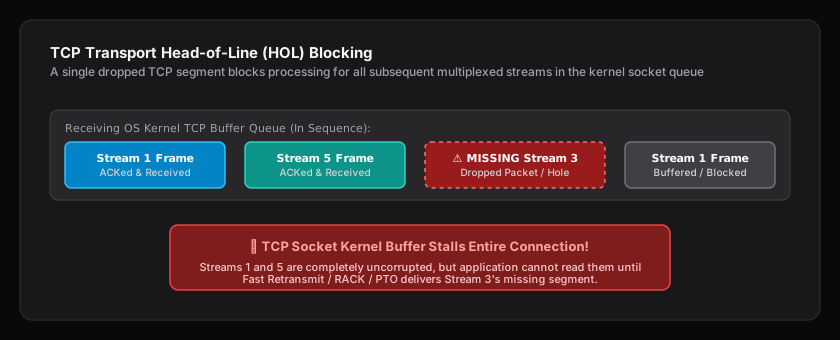
In high-loss wireless environments (e.g., mobile cellular or congested Wi-Fi with 2% to 5% packet loss), HTTP/2 throughput across a single TCP connection can degrade below HTTP/1.1 across multiple connections. To learn more about byte-stream pointer mechanics, refer to our deep dive into TCP Congestion Control & Flow Control Mechanics.
HTTP/3 and QUIC: UDP-Native Architecture
HTTP/3 (RFC 9114) replaces TCP entirely with QUIC (RFC 9000)—a transport-layer protocol implemented on top of UDP datagrams. QUIC handles transport reliability, congestion control, and stream multiplexing directly in user-space or specialized kernel implementations.
1. Independent QUIC Streams over UDP
In QUIC, streams are first-class transport primitives rather than an application-layer framing abstraction. A QUIC packet typically carries one or more QUIC frames tagged with specific Stream IDs.
QUIC performs loss detection and recovery at the packet level rather than locking the entire stream interface. When a UDP packet containing a STREAM frame for Stream 3 is lost on the network:
- QUIC’s loss detection algorithms identify the lost packet number using Packet Threshold Loss Detection or Time Threshold Loss Detection (RFC 9002).
- The sender retransmits the missing
STREAMframe payload inside a new QUIC packet with a new packet number. ACKframes in QUIC acknowledge ranges of received packet numbers.- Unrelated streams (e.g., Stream 1 and Stream 5) continue making progress and are delivered directly to the application layer without waiting for Stream 3’s retransmitted packet.
2. Integrated TLS 1.3 Cryptography
Unlike HTTP/2, which layer-stacks TLS over an established TCP connection, QUIC tightly integrates the TLS 1.3 cryptographic handshake directly into its transport setup.
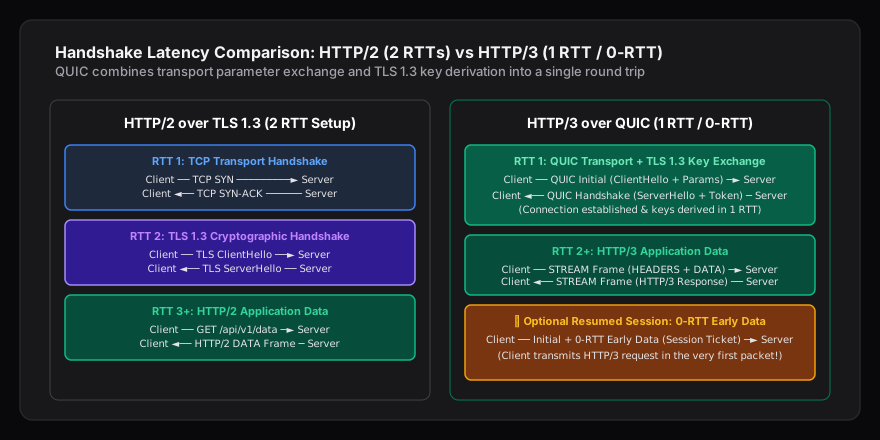
By combining transport parameters and TLS 1.3 key exchange into the initial UDP exchange, QUIC achieves a 1-RTT connection setup for new destinations, and 0-RTT early data transmission for returning endpoints with valid session parameters. For a deeper breakdown of key derivation, consult our guide on TLS 1.3 Mechanics & Handshake Optimization. You can also verify edge crypto policies using our Security Headers Inspector.
Connection Migration via Connection IDs (CIDs)
Traditional TCP connections are bound to a 4-tuple: (Source IP, Source Port, Destination IP, Destination Port). When a mobile user shifts from Wi-Fi (192.168.1.45) to a cellular network (172.56.12.89), the source IP address changes, forcing the OS to send a TCP RST and tear down the connection.
QUIC solves connection dropouts using variable-length Connection Identifiers (CIDs) (up to 20 bytes / 160 bits) embedded in packet headers.
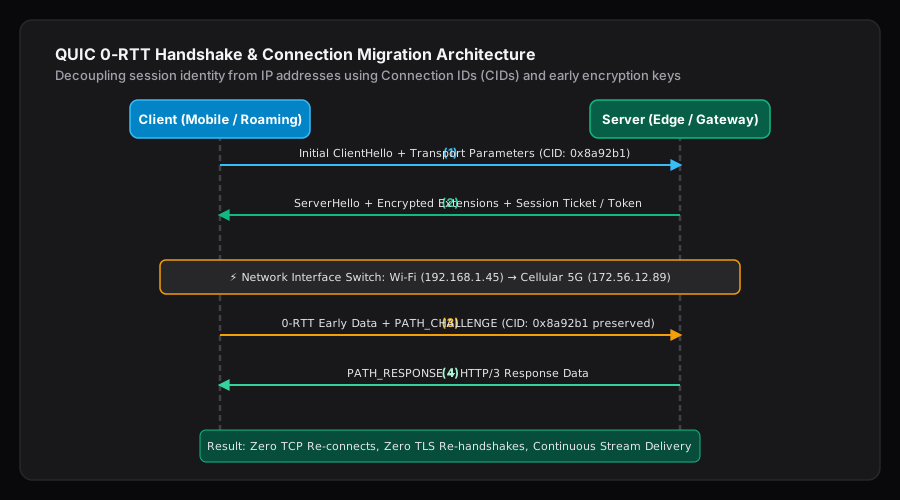
When the client’s network interface switches:
- The client transmits a QUIC packet from its new IP address containing the existing Connection ID (
CID: 0x8a92b1). - The server receives the packet, recognizes the CID, and validates the reachability of the new network path using a lightweight
PATH_CHALLENGEframe. - The existing session, TLS security context, and open HTTP/3 streams continue uninterrupted without re-authenticating or dropping active requests.
QPACK: Out-of-Order Header Compression for HTTP/3
Because HPACK in HTTP/2 relies on strictly ordered TCP delivery to ensure client and server dynamic table updates arrive in exact sequence, attempting to use HPACK over QUIC’s independently delivered streams would reintroduce cross-stream head-of-line blocking whenever a dynamic table update frame was delayed.
HTTP/3 introduces QPACK (RFC 9204), designed specifically for out-of-order stream delivery.
QPACK Architectural Components
QPACK splits header compression state into three separate channels:
- Request/Response Streams: Carries indexed header representations referencing static or dynamic table entries.
- Encoder Control Stream (Unidirectional): Transmits dynamic table updates from the encoder to the decoder.
- Decoder Control Stream (Unidirectional): Sends acknowledgments back from the decoder to free dynamic table memory.
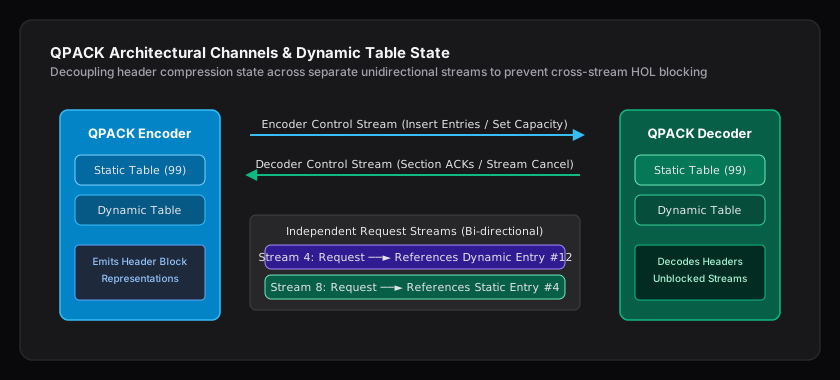
If a stream references a dynamic table entry that has not yet arrived on the Encoder Control Stream, QPACK allows the decoder to pause only that specific stream while allowing all other streams to render immediately.
Protocol Comparison Matrix
| Feature / Dimension | HTTP/1.1 | HTTP/2 | HTTP/3 (QUIC) |
|---|---|---|---|
| Transport Protocol | TCP | TCP | UDP (QUIC) |
| Data Format | Plain Text (ASCII) | Binary Frames | Binary Frames |
| Multiplexing | No (Sequential / Pipelined) | Yes (Shared TCP Stream) | Yes (Independent QUIC Streams) |
| Head-of-Line Blocking | Application & Transport Layer | Transport Layer Only (TCP) | No cross-stream head-of-line blocking |
| Header Compression | None | HPACK (Stateful / In-Order) | QPACK (Stateful / Out-of-Order) |
| Handshake Latency | 2-3 RTTs (TCP + TLS) | 2-3 RTTs (TCP + TLS) | 0-1 RTT (Integrated TLS 1.3) |
| Connection Migration | Unsupported (Bound to 4-Tuple) | Unsupported (Bound to 4-Tuple) | Supported via Connection IDs |
| Security Requirement | Optional TLS | TLS optional in RFC 7540 (h2c), required by browsers (h2) |
Mandatory Integrated TLS 1.3 |
To evaluate how transport overhead impacts global packet arrival trajectories, see our analysis on The Mechanics of Network Latency. For edge gateway routing configurations, explore Layer 4 vs Layer 7 Load Balancing.
Summary and Production Guidance
Adopting HTTP/3 at the edge yields immediate latency improvements for mobile clients and high-loss wireless connections:
- Enable HTTP/3 at Edge Proxies: Modern edge gateways (such as NGINX 1.25+ built with the
--with-http_v3_moduleQUIC module, Envoy, Caddy, or Cloudflare) support HTTP/3 terminate-and-proxy. They advertise HTTP/3 availability using theAlt-Svcheader:Alt-Svc: h3=":443"; ma=86400 - Keep HTTP/2 for Internal Microservice Mesh: Since internal data center networks feature sub-millisecond latencies and negligible packet loss, HTTP/2 over gRPC remains the gold standard for high-throughput service-to-service communication.
- Tune UDP Buffer Sizes: Because QUIC operates in user-space over UDP, Linux host kernels require larger socket read/write buffers (
sysctl net.core.rmem_max=16777216) to prevent UDP datagram drops under heavy burst traffic.